Thursday, August 21, 2008

2008 summer cruise - part II

After three days in the lonely lagoon we decided it was time to head back into civilisation once more. In a few days we were to meet with Helinä from Finland and Nigel and Tommy onboard Marie, all part of the SBC (Small Boat Club's) Baltic section. The meeting was decided to take place at the restaurant dock at Ornö, mostly because forecasts now started to mention an end to the high pressure weather. There were even first hints of a storm coming through during the week-end. However, before sailing to Ornö we wanted to visit Fjärdlång, an island on the outside of Ornö. We sailed there in light winds and some drizzly rain that started to become more intense as soon as we reached the anchorage. There were quite some boats inside and more were to come the next day. Then Helinä arrived as well. Jukkas catamaran can by no means be described as a small boat, despite him being a member of SBC. He and his crew dropped anchor just inside the inlet. Later they came to visit us with the dingy. We then decided to move Discovery and raft up to Helinä to share dinner in the cat's big saloon. Photobucket

Here the doggy person, named Tinka, examines the rafting arrangements. Alongside Helinä Discovery really did not feel so big... Photobucket

The second picture was taken the next morning when I took Helinä's dinghy out to take some photos of the boats. That morning the winds were light and the weather was sunny, but in the afternoon and coming night the winds were to increase and develop into one of the quite unusual heavy summer storms. We sailed towards Ornö quite early and in the beginning we took some pictures of the boats under sail. Not too much wind in the sails though. This is Helinä. Photobucket

Photobucket

Doggy person in the famous position on the bow. And this is Discovery with her new high jib, taken by Helinä. Photobucket

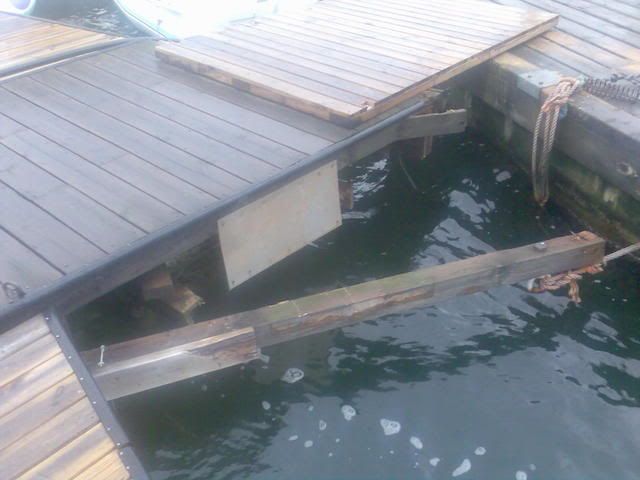
A few hours after we arrived at Ornö, Marie with Tommy and Nigel arrived as well, just in time for dinner at the restaurant while ouside the storm was starting to get up with rain and heavy winds. The storm in fact increased during the night and Discovery was bouncing around considerably at her mooring. I went out three times during the night to double the lines or secure things or just because I couldn't sleep and it felt good to be doing something. In fact I did realise that Marie's decklights were on but I put that down to them wanting to check their lines as well. However, the truth was they just had forgotten to switch them off, thus effectively draining their battery. The next morning we found everything still in place, except that Helinä had snapped a mooring ring with bolt out of the dock thus even ripping out the beam it was attached to. Photo by Nigel. After the storm finally abated Helina left for home while Marie and Discovery continued to cruise together some more days. In fact, we just decided to meet at Kymmendö, the same anchorage we visited during the first week of the cruise. Marie went around the outside of Ornö while Discovery first stopped at the next bay to collect a delivery of white wine ordered the day before. This was the first time I used the famous Trouville outboard I got from Tommy who did not want to have it hanging on his boat. Of course I gladly offered to relieve him of it, stowed the little Honda below and hung the big Tohatsu-San on the back, speeding away in 5.1 knots instead of the usual 3.5. The engine in fact was so powerful I had difficulties not to ram the dock at Vargvik the first time I used it. That it immediately tilted up when I put it in reverse did not help either. Otherwise it was a great improvement. That evening we moored both boats to a rock and had a barbeque. It did not rain either. Photobucket
The next day we decided to sail to Härsö again. There was lots of rain in the forecast and Härsö is a good place to wait out some bad weather. However we did not sail together. While Discovery sailed at once, Marie's crew first paid a visit to the Hamburger Bar at Kymmendö. Also Discovery sailed all the way in grand style, in rain, bad visibility (nav lights on even!) and a quite strong following winds. At one time we made 5.5 knots with only the mainsail up. Nigel and Tommy on the other hand, waited in the Hamburger Bar until the rain stopped and then just motored over. In order to charge the batteries. Yeah, right. That evening, Marie missed dinner for some reason, but afterwards we had a nice chat over a quantity of whiskey on the dock. It got quite late actually (both Nigel and my wife retired in due time while Tommy and I bravely defended the place against the mosquitoes and the rain some more hour.) The next morning Marie left. Photobucket

Weather, at least then, was apparently good enough for crew to be almost naked. Continue to part III

Three and a half adventurous weeks

This year's cruise was probably the longest ever in time. I was living on the boat continuously for 24 days which is three days more than last year. Even this time I started together with my wife, who left the boat after two weeks. I then was alone a few days before my father joined me for another week. Weather wise it has been mixed, the first week was really hot and warm, but then the weather became more traditionally Swedish with lows coming through. This summer we also had a real storm, in fact the worst one I have been through on the boat (or any boats). But let's start from the beginning. Our plan this year had been to head north through the main ferry lane. We usually avoid this because of the heavy traffic but after several years going out into the outer archipelago via the "middle route" we got fed up with it and decided to try something else. Of course this was not to be. Due to persistent northerly winds we decided to take the southerly route through Baggenstäket instead, this forcing us to have to lower the mast to get under the Lidingö brigde first. This bridge is a lifting one, but the town being responsible for it's maintenance finds it too expensive and has been dragged thought the courts for years while not opening the bridge in the process. At first we had some trouble getting out the lower bolt in the mast tabernacle but after some serious wriggling it came out and the mast came down. After a short motor under the brigde we raised the mast again and set sail at last. Of course we discovered that the wind was not northerly at all. Having been overcome by the sea breeze it gave way to light southerlies instead. Still we made it to the entrance to Skurusundet by sail. There we had to start the engine and basically motor through the whole narrow passage of about six nautical miles. This passage is one of three ways to get out into the archipelago from central Stockholm and of course this made it paradise for wash-creating motorboats. Photobucket

The picture shows one of the nice houses along the route. Unfortunately the camera did not work that well this season and some pictures have interesting color effects. After having made it through the narrowest part we could set sail for about an hour and make way towards the next passage when we got a strong headwind again. By now it was late in the afternoon and the engine had to work again in order to make it to Harsö, our club harbour in resonable time. After seven hours of passage we finally made it there. We stayed there for three nights, enjoying the quieteness. For some time we even had the dock for ourselves. Photobucket

The weather during that first week was really hot and sunny with only very light winds or the sea breeze. Unfortunately this had caused the algae to thrive in the Baltic and we had to cope with quite of it in some anchorages. However concentration was erratic and some places where completely free of the stuff. On day four, July 30 we left Härsö and sailed almost all the way to Kymmendö in mostly light winds and sunny weather. It was no fast sail, but quite pleasant. Kymmendö is known as the island where one of Swedens more famous writers, August Strindberg, used to write his books. We stayed in an anchorage that is quite open towards the north but has good shelter against anything from the south. Photobucket

The water really isn't that green, it's the camera playing up again. Albeit the anchorage was nice enough there were quite a few boats so we decided to make for a more quiet place the next day. It started with some engine trouble which, however, soon was fixed by actually opening the fuel vent (oops). We then had another great sailing day in a little stronger winds, mostly on a beam reach and with bits of open horizon to the east. After about four hours we had found our quiet place, on the northern end of Jungfruskär. Two nights without another boat in sight. First we stayed on the northern shore but moved the next morning when the wind shifted into the northeast. The second spot was really perfect. A small lagoon with an entrance only about four metres wide. Inside the depth was one meter (1.3 according to the chart, but we had high pressure long enough to make the water level sink) all the way to the rocks. Mud bottom without a single rock inside. Photobucket

This is the view from the inside of the lagoon. The narrow entrance is to the right. Photobucket

And this is the view inside standing next to the entrance. That noon there was a partial solar eclipse which we actually saw. I even tried to photograph it but it did not work very well. Photobucket

During the second evening a big thunderstorm passed right over us, I think there were lightning strikes on the island on the opposite side of the lagoon. Afterwards we got a nice evening. Just before sunset some sheep suddenly appeared on the shore... Photobucket

Continue to part II

Wednesday, August 13, 2008

Discovery scrap album

Here are a bunch of unused pics from the old site and other surplus pictures of my own boat.

Thursday, July 17, 2008

Another mainsheet solution


Tony from the UK sent me this picture of how he arranged the mainsheet traveller. His boat is a Vivacity 21, but the sheet arrangement is the same as on the Alacrity/Vivacity. When I first saw the picture I wondered what the benefit of the rope really would be as I reckoned the block would move almost in the same way as would a shackle on the iron bar. This is Tony's reply:
With the traveller it all depends on how tight the rope is, if it's longer and looser than the one shown then the block will travel further, but I found a length I was happy with and cut it to that length.
Funnily enough, it doesn't seem to travel very far which seems better. If it was tightened up even more it would remain more or less fixed in the centre position. But you are right, it is a similar arrangement to the original.


Now I think the main problem with the original setup is that in a beat you sometimes want the block (or shackle) to be to windward, not just in the middle. I am not sure if Tony's arrangement does make this possible.

Monday, June 23, 2008

Around Britain in 19 feet

OK, it's not an Alacrity, but I think this is still worth mentioning: British journalist Dylan Winter is currently sailing around Britain in a 19 foot Mirror offshore tripple-keeler. He documents it on video which he uploads on YouTube for all to see.
This is an ongoing project as he is working at the same time, sailing in his spare time and leaving the boat i different ports when back at work. There are currently 16 short episodes of the documentary, all very professionally done and definitely worth watching!

Tuesday, June 17, 2008

Mainsheet traveller solutions


The Alacrity has, as her Vivacity sister, a very simple mainsheet arrangement. The sheet block and cleat just is attached to a solid bar via a shackle. The shackle can slide freely from side to side.
There has recently been a discussion on the Alacrity yahoo-group if this is sufficient or not.
While the shackle lets the sheet move relatively freely I did not find this a problem myself. In fact, if the sheet is sufficiently tight the shackle does tend to stick on the bar. This can be used to sheet the sail to windward in a tack. At the same time it is very easy to "unstick" the shackle in a gust thus slightly depowering the sail.
However, if a more professional, or "racy" approach is desired there are some solutions. The easiest is using a piece of rope (and maybe some blocks) to harness the shackle and make the sheet adjustable.
Or, you could remove the simple traveller completely and build a new one, for example as described in this article by George Bollenbacher. You will then end up with something like this: